
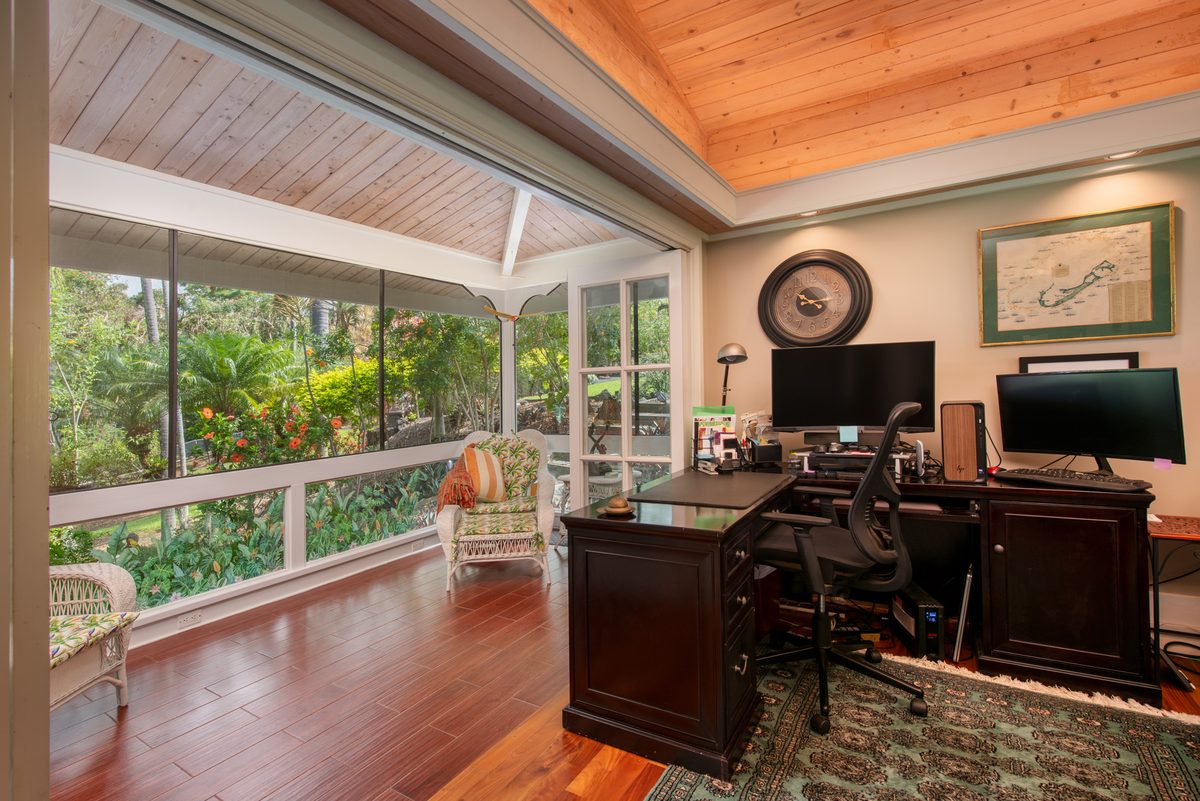
Founders, executives, board members, and investors who plan to work from a home on Hawaiʻi Island for some or all of the year, and need it to perform like an office.
At many Kona and Kohala Coast addresses, yes, but it is address-specific. High-speed cable broadband is widely available in Kailua-Kona, and Hawaiian Telcom announced in January 2025 a $1.7 billion, multi-year fiber build aimed at making Hawaiʻi the first fully fiber-enabled state by 2026. Satellite service such as Starlink is available across the island and is a common backup.
What to do for a specific property:
Hawaiʻi Island's grid is run by Hawaiian Electric, and electricity in Hawaiʻi costs far more than the national average. Many luxury homes have rooftop solar; the questions that matter are whether the system is owned or leased, how large it is, and whether there is battery storage that keeps the home running during an outage. Hawaiian Electric reported reaching 37% renewable energy across its five-island service area in 2025.
For a home office, ask whether the battery backs up the whole house or only essential circuits, and make sure the office, network equipment, and refrigeration are on protected circuits. Underground utilities on the property also reduce storm exposure. Angel’s Retreat in Holualoa is one example with owned solar, Tesla battery backup, and underground power.
Hawaiʻi uses Hawaiʻi Standard Time (UTC−10) all year and does not observe daylight saving time. That means:
| When it is 8:00 a.m. in Kona | Mainland time (approx.) |
|---|---|
| Pacific (Nov–Mar / Mar–Nov) | 10:00 a.m. / 11:00 a.m. |
| Eastern (Nov–Mar / Mar–Nov) | 1:00 p.m. / 2:00 p.m. |
| Tokyo | 3:00 a.m. the next day |
Executives with East Coast teams often start very early. Those with teams in Asia and Australia find Hawaiʻi afternoons overlap with the next business morning there.
Kona International Airport (KOA) has nonstop flights to San Francisco, San Jose, Los Angeles, San Diego, Seattle, and Portland, with year-round or seasonal service to other mainland hubs and Vancouver. Flights to San Francisco take about five and a half hours. Frequent inter-island flights connect to Honolulu for more international options. KOA also serves private aircraft. Many homes in Kailua-Kona and on the Kohala Coast are a short drive from the airport; ask for the actual drive time for any property you consider.
Living and working in Hawaiʻi can create Hawaiʻi tax, payroll, and registration obligations for you and possibly your company. These questions belong with your CPA and corporate counsel before you move. Marco does not advise on them, but understands why they matter to the timing of a purchase.
Not tax or legal advice. Marco In Kona does not provide tax, legal, lending, or investment advice. Review this with your own CPA, attorney, or advisor before acting.
Buyers who want everything handled tend to choose the Kohala Coast resort communities, such as Hualālai and Kohanaiki, close to KOA. Buyers who want land and quiet often choose Holualoa's upcountry estates. Buyers who want oceanfront near town look along Aliʻi Drive and in Keauhou. See current properties.
Yes. Many Kona and Kohala Coast homes have high-speed cable or fiber internet, and satellite service is widely available as a backup. Hawaiʻi Standard Time is two to three hours behind the West Coast, so East Coast schedules mean early mornings. Verify internet and power at the specific property before buying.
Fiber and high-speed cable are available at many Kailua-Kona and Kohala Coast addresses, and Hawaiian Telcom announced a $1.7 billion plan in 2025 to bring fiber statewide by 2026. Availability is address-specific, so check by exact address and ask the Seller for recent speed tests.
Kona uses Hawaiʻi Standard Time (UTC−10) all year, with no daylight saving time. It is two hours behind Pacific time from November to March and three hours behind from March to November.
Nonstop flights between Kona International Airport (KOA) and San Francisco take roughly five and a half hours. KOA also has nonstop service to other West Coast cities, including San Jose, Los Angeles, San Diego, Seattle, and Portland.
Some do. Look for owned (not leased) solar with battery storage, and ask whether the battery covers the whole house or essential circuits only. Homes with underground utilities on the property are also less exposed to storm outages.
Last reviewed October 15, 2026 by Marco A. Silva, Coldwell Banker Island Properties (RB-20599). Information is believed reliable but not guaranteed, and laws, tax rates, and flight schedules change. This page is general information, not tax, legal, lending, or investment advice.
Hawaiʻi Island Buyer Guides